

When a large professional services firm decided to launch a new global brand and people value proposition, they faced a unique challenge: how do you create consistency across hundreds of thousands of employees in a network of corporations that are used to being locally led?
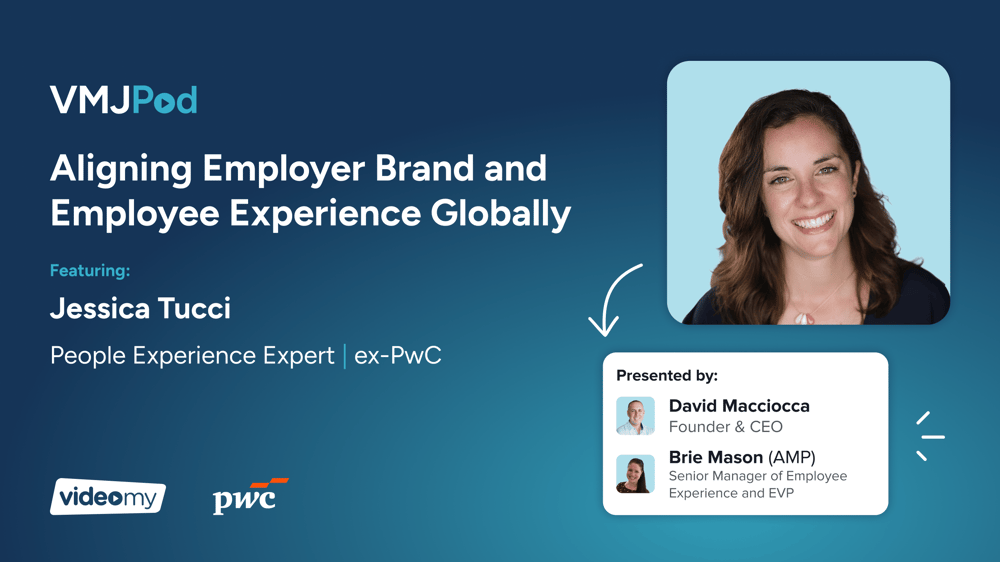
Jessica Tucci, who has spent fifteen years in employer brand and people experience, recently joined the VMJPod to share how she helped navigate this massive transformation, and why starting internally is the only way to build an authentic external brand.
Building From the Inside Out
For Jessica, the fundamental principle is clear: "Brand starts from the inside out, right? Everything is about brand that then rolls through to people experience."
This isn't just philosophy, it's practical strategy.
"It's your people delivering to your clients," she explains. "If you nail that, that's when you get a really authentic employer brand and a really consistent and memorable experience from both the brand for the people and the client experience point of view."
This truth holds regardless of industry. Whether you're selling professional services, tech products, or data centre space, people are still at the centre.
"Those people are servicing them. They're selling the contracts, they're setting them up," Jessica notes. The question isn't whether your people matter to your brand, it's whether you're intentionally aligning your internal and external promises.
Start With Education, Not Activation
When rolling out a new global brand and EVP, the temptation is to move quickly to market. Jessica's approach is different.
"You need to start with education," she emphasises. "People need to understand what your brand promise is. They need to know how you got there and why is it important."
The firm began by educating the right teams first: marketing communications, employer brand, people and culture teams, and critically, leadership.
"You need to get them all embedded and educated on why the change is occurring, what it means, how you're designing it, and your aspirations for where you want to go," Jessica explains.
This wasn't a six-month sprint. It was a three-year journey to ensure what they were saying externally was genuinely reflected internally.
The McDonald's Principle
To achieve global consistency while respecting local nuances, Jess points to the world's most successful brands. "The most powerful, memorable brands are consistent," she observes. "Macca's burgers are Macca's burgers, wherever you are, right? You walk into a restaurant, it's the same no matter where you are in the world."
The key was establishing fixed brand guidelines. Visuals, tone of voice and messaging that couldn't be altered.
"You can't err off those key global messages because that's when it starts to become fragmented and disjointed," she warns. While this represented a significant shift for a network accustomed to local autonomy, the consistency became a competitive advantage.
Embedding the Promise in Every Program
The real work began when the brand needed to come to life across every employee touchpoint. Jessica's team set up activation teams across people and culture, working as advisors on everything from performance cycles to goal setting.
"How is that program being communicated to the business? That's where we come in and say, 'hey – new brand, new sentiment, new tone of voice, new message. Make sure that everything you're saying has that messaging embedded.'"
This internal storytelling is different from campaigns. "We talk about storytelling a lot in terms of campaigning," Jessica notes. "But this is internal storytelling about why processes and structures exist and how they're going to help."
Measure Belief, Not Just Reach
When it comes to metrics, Jessica focuses on whether the message is landing, not just how loud it's being shouted. The firm measures success through engagement scores, intent to stay, attrition, retention of top performers, and recommendations.
"We needed to start internally first because if you don't start with your people, then it's not going to be an authentic promise out to the market," she explains.
The real validation comes from leadership. "The moment it lands is when your leaders start talking about it and they're saying, 'this is what our EVP means to me.' I'm like, yes, we've done it."
Jessica's three key takeaways?
"Start inside – if employees don't believe it, candidates and clients won't either. Simplify your story – if people can't repeat it, they can't live it. And measure belief, not just reach."
🎥 Watch the Episode
🎧 Listen to the Podcast