

Starting a new employer brand role can feel equal parts exciting and overwhelming, especially when the role is newly created or not fully understood across the business.
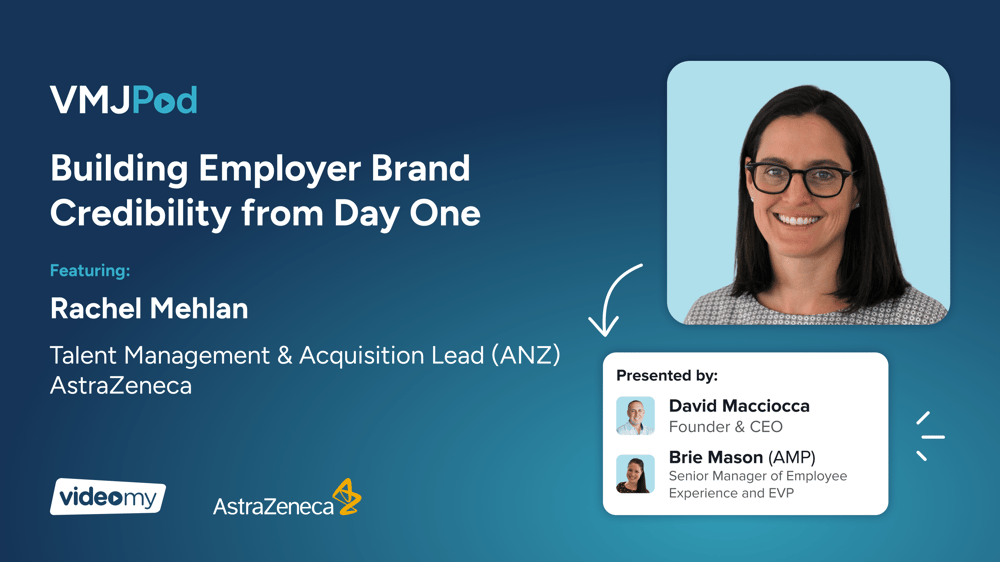
In a recent episode of the VMJPod Employer Brand Series, Rachel Mehlan, Talent Acquisition and Management Lead at AstraZeneca joins hosts David Macciocca and Brie Mason to share practical advice drawn from more than two decades in recruitment and talent.
Her insights offer a clear roadmap for employer brand and talent professionals looking to build credibility, align with business goals, and create impact quickly. Read on to learn how to hit the ground running in a new Employer Brand role.
Start With Business and Industry Understanding
One of Rachel’s strongest recommendations for anyone stepping into an employer brand role is to focus first on understanding the broader context the business operates within.
“I think one of the key things to really unpack, particularly when you're new to an industry, is what's going on in that industry,” she explains. “What that means is really understanding the economic, social and financial impacts to that industry because ultimately that's going to impact the labour force.”
Rather than jumping straight into campaigns or content creation, Rachel emphasises the importance of aligning employer brand strategy with organisational priorities. By understanding the business strategy first, employer brand professionals can ensure their initiatives directly support hiring, workforce planning, and long-term organisational growth.
“From there you can align on how employer brand will ladder up to that first and foremost,” she says.
Build Relationships Through Listening
Rachel highlights stakeholder engagement as one of the most critical early steps in a new role. Instead of starting with senior leadership, she recommends taking a bottom-up approach by speaking with employees across different functions.
“I’ve just gone and met as many people as I possibly could,” she shares. “Start bottom up… until you've got a really clear understanding of the strategy and the pain points.”
These early conversations help uncover internal challenges, priorities, and opportunities for employer brand to create real value. Rachel also recommends connecting with communications, marketing, and corporate affairs teams early, as they often hold valuable brand and messaging insights.
Beyond information gathering, these conversations help build trust and demonstrate curiosity — two traits that help employer brand practitioners position themselves as collaborative partners rather than standalone specialists.
Translate Employer Brand Into Business Language
A common challenge Rachel encounters is that many stakeholders don’t fully understand what employer branding actually involves — even those working in related functions.
“Even people in marketing or comms, when you start talking about employer brand, they just glaze over and don’t really know what it means,” she says.
To overcome this, Rachel encourages employer brand professionals to frame their work in terms that resonate with each stakeholder group. For hiring managers, this might mean focusing on hiring speed or candidate quality. For HR leaders, it could be workforce retention or engagement outcomes.
“It’s using the language that they use rather than employer brand, because nobody knows what that means,” she explains.
Rachel also stresses the importance of focusing conversations on results rather than outputs. Instead of talking about content creation or social engagement metrics, she recommends highlighting measurable business outcomes.
“I don’t talk about videos and content and LinkedIn likes… I talk more about the outcomes,” she says. “If we write an authentic people story and use it to promote a job ad, we’ll get a higher number of applications.”
Partner With Marketing and Communications Teams
Strong collaboration with marketing, brand, and corporate affairs teams is another key success factor Rachel identifies. While these teams can sometimes be perceived as gatekeepers, Rachel encourages employer brand professionals to approach them as strategic partners.
“I think a good idea is to really empathise and understand what they do,” she says. “It’s not about giving them more work. I just want to know what the guard rails are.”
By understanding brand guidelines, social strategies, and tone of voice frameworks, employer brand professionals can ensure consistency while building credibility. Rachel also suggests identifying internal advocates within marketing teams, particularly emerging talent who may help champion new ideas internally.
Balance Global Resources With Local Authenticity
Working within a global organisation brings additional opportunities — and challenges. Rachel highlights the importance of leveraging existing global brand assets while ensuring local relevance remains strong.
“Making the most of the assets that already exist” can accelerate employer brand efforts, she explains, but it’s equally important to tailor messaging and storytelling to reflect local employee experiences and culture.
Building Momentum Through Strategic Alignment
Ultimately, Rachel’s advice centres on one core principle: employer branding succeeds when it is deeply connected to business outcomes and supported by strong internal relationships. By prioritising listening, aligning with organisational goals, and demonstrating measurable impact, employer brand professionals can quickly establish credibility and deliver meaningful results.
Her experience offers a reassuring message for anyone stepping into a new employer brand role — success doesn’t come from launching campaigns quickly, but from building understanding, trust, and strategic alignment from day one.
🎥 Watch the Episode
🎧 Listen to the Podcast