

When organisations develop a global employer value proposition, they often assume the hard work is done. Then comes the moment a local team opens the document and realises: this doesn't speak to us.
With nearly 20 years in working with global employer brands, both in-house at BP and on agency-side at TMP, Jenny Roberts has seen this disconnect countless times. Her advice? Stop translating and start transcreating. Because a message that resonates in New York can fall completely flat in Shanghai.
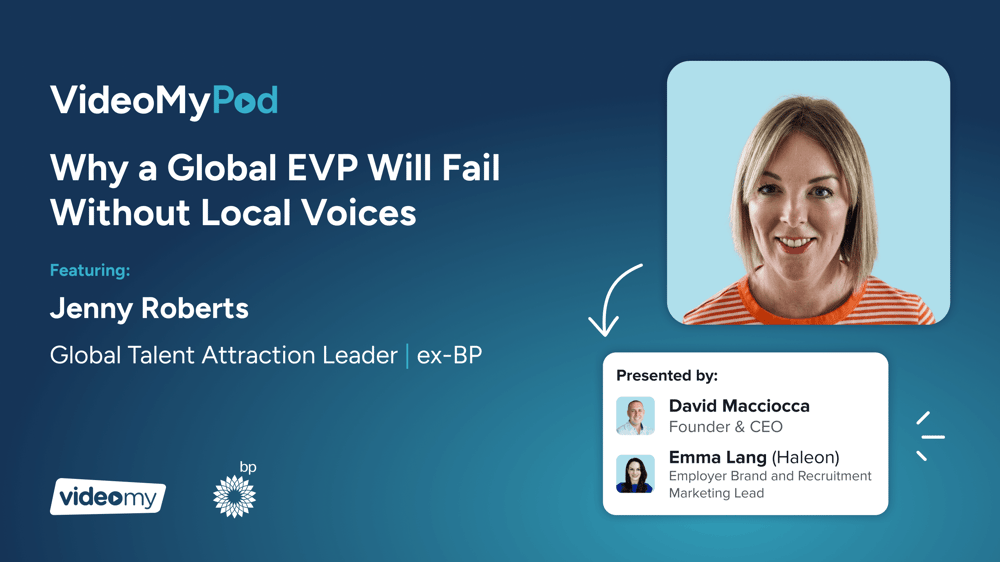
Jenny recently joined the VideoMy Pod to chat with hosts David Macciocca (VideoMy Founder) and Emma Lang (EB Lead at Haleon) about the importance of using to local voices to bring your EVP to life.
The Transcreation Imperative
"When you're given something, you need to be thinking about transcreation," Jenny explains. "You don't want to lose the sentiment of what you're trying to get across from a global point of view, but you want to make it relevant to that local market without losing that sentiment."
The stakes are higher than most realise. A clever Western headline loses all meaning in translation. A fun slogan becomes confusing or even offensive. "A straight translation of that message will lose all its meaning," Jenny warns. The solution isn't a translator, it's a strategic partner who understands both the global vision and local nuances.
"You become the translator effectively on both sides. You've got to translate what Global's trying to achieve, listen to the local market, and then find that halfway house that makes both sides happy."
Your EVP Pillars Stay, Your Proof Points Change
The framework matters here. Your core EVP and pillars should remain consistent globally, assuming they were researched properly across key markets. But how they're expressed? That's where localisation lives.
"Your core EVP and your pillars globally would remain the same, but how they're expressed in the local market would be different," Jenny explains. "If you're talking about growth, what pinpoints growth in different markets would be very different. In one market, it might mean fast career development. In another market it might be more about learning opportunities or stability or leadership."
Proving this difference to global stakeholders requires something they love: data. "Stakeholders love a bit of research. You throw some data at them," Jenny notes. Internal focus groups, stakeholder interviews, and real-world campaign successes are your ammunition.
When Jenny's team ran a campaign for shared services roles in India, they documented everything: platforms used, resonance points, number of applications, quality of hires and brand awareness lifted. When technology roles needed hiring in the same market, that case study became their playbook and their proof.
Platforms Aren't Universal, And Neither Should Your Approach
Platform differences reveal how deep localisation must go. "If you are localising a messaging, you could run some tests, you could do some focus groups," Jenny recommends. But more fundamentally, where you advertise changes dramatically by market.
"In China, you can't even be advertising on LinkedIn anymore if you want to reach an audience. You're utilising platforms like WeChat."
This isn't just about posting to a different platform. WeChat isn't LinkedIn. It's where people pay taxes, buy food, and apply for jobs. The "page" experience is entirely different. "It comes down to education. How do you educate people that have never used WeChat to show them this is where people apply for jobs?"
Equip Your Recruiters as Localisation Partners
Many organisations see recruiters as gatekeepers – sometimes adversarially. Jenny flips this perspective. "A recruiter toolkit shows recruiters how to talk to candidates, what we're saying externally because you want it to be authentic when people go through that recruitment process."
Give them guidelines, equip them with information, and empower them to localise in their moment. They're not another approval layer; they're a crucial translation medium between brand promise and candidate reality.
Start With Education, Stay Connected
Jenny's final advice for organisations beginning their localisation journey?
"You need to take it back to basics and it's got to come down to that education because you're going to need to educate your global stakeholders." But education isn't a one-time briefing. Once campaigns launch, stay connected.
"Once something's live, you're kind of then not connected. It's really important to stay connected with them and keep them up to date with the campaign."
This ongoing relationship transforms stakeholders into advocates. They become champions who can speak to your expertise and share what you've accomplished. They're the proof that localisation isn't fragmentation – it's strategic relevance.
As Jenny puts it: "Partner early and often."
🎥 Watch the Episode
🎧 Listen to the Podcast