

When Martin Warren sat down with senior engineering leaders at Grab, Southeast Asia's equivalent of Uber, he had a simple proposition: what if recruitment outreach came directly from you instead of the talent team?
The results were staggering.
Reply rates jumped from 25-30% to 80%. After 25 years in recruitment and seven years building Grab's sourcing function, Martin has cracked a code that most organisations overlook – hiring managers are your most under-utilised recruitment channel.
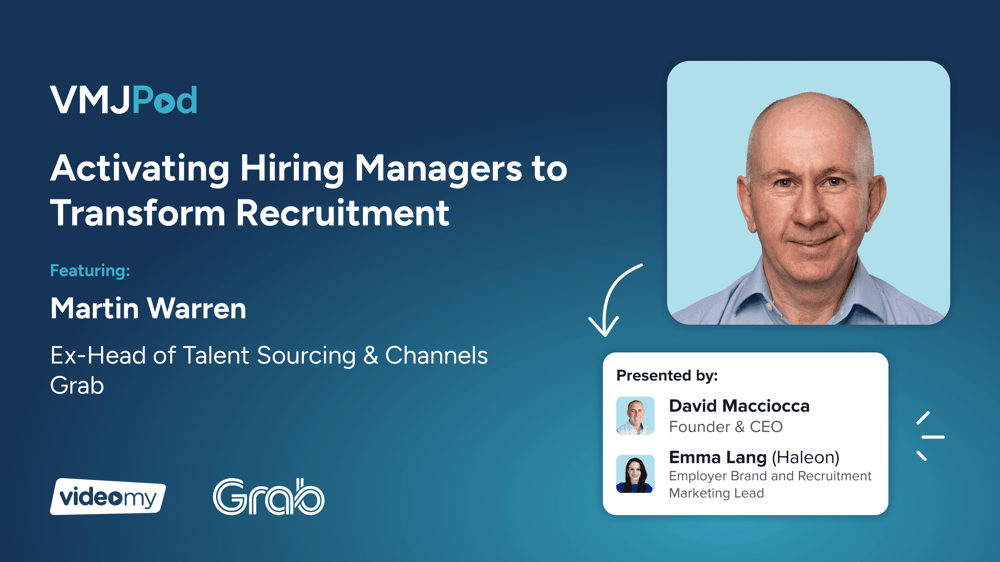
Martin recently joined the VMJPod' Singapore series (hosted by VideoMy's David Macciocca and Haleon's Emma Lang) to discuss how he helped build a leading sourcing function with hiring managers at the core.
The Speed Problem
At Grab, speed was everything. "The love drug at Grab was speed," Martin explains. The challenge wasn't just filling roles across eight Southeast Asian countries, it was filling them fast with quality talent. Traditional recruiter outreach was yielding decent open rates but disappointing reply rates, even when emails were well-crafted.
Martin's insight was simple but powerful: "Recruiting is a team sport. If you can address and understand the pain of a hiring manager, it gives you leverage to influence them and get them into the team sport of recruiting."
The pain point? Speed to hire quality candidates. The solution? Make hiring managers the face of outreach.
Making Candidates Feel Special
The strategy was elegantly simple. Using a sourcing platform integrated with hiring managers' email and calendars, Martin's team built sequenced email campaigns, typically four to six messages over time, that appeared to come directly from senior leaders.
"We wanted to show to the candidate that you're special," Martin notes. "Coming from head of engineering? An email to me who was a back-end developer of eight or nine years experience, to get it from the head of engineering? Wow. Special, right?"
The psychology is powerful. When a recruiter reaches out, candidates are skeptical.
"Candidates have little or no trust in recruiters because we don't get back and we're not transparent," Martin admits candidly. But when a head of engineering personally invites someone to a conversation? That changes everything.
The First Informal Call
The magic didn't stop with higher reply rates. Martin introduced another game-changing element: the first conversation wasn't a formal interview. "We're not interviewing you. It's a very casual, informal call to understand whether you're interested and what you're looking for," he explains.
This shift in framing transformed the quality of conversations. "Candidates tend to ask more impactful questions – information that they really need to start to move from the back of the bus towards the front," Martin observes.
These weren't just better conversations; they provided gold dust for employer brand teams. Understanding what candidates actually care about informed the next campaign, the next piece of content, the coaching for future hiring managers.
Starting Small, Thinking Practical
Not every organisation has sophisticated sourcing platforms or dedicated sourcing teams. Martin's advice? Start manually.
"Let's just send the outreach from you for three or four candidates. Give them the emails. If you don't have the technology to automate it, then maybe you've got to do it manually. You can write the email for them. They can send it from their email address."
His recommendation is counterintuitive: don't necessarily start with your friendliest hiring manager. "I've had hiring managers that had given me a really hard time. Maybe you go to one of those hiring managers that is not happy and give them this idea. If they're not willing to give this a try, then maybe they're more the problem than you are."
The risk is high, but so is the reward. "They could end up being your huge ambassador and cheerleader for you."
Ringing Your Own Bell
Martin also advocates for something recruiters often neglect: self-promotion. "We need to be a little bit selfish and go out and do this sort of stuff and then shout it from the rafters in terms of what we did. I think we just sit back and we're not telling the business the impact that we're having."
The formula is straightforward: understand hiring manager pain, give them ownership of outreach, frame initial conversations as informal, measure the impact, and broadcast your wins. As Martin puts it, "The definition of insanity is doing the same thing expecting different results. If I'm not trying different things, then I should just move aside and let someone else do it."
When a head of engineering's email lands in your inbox, you pay attention. That's not magic. It's strategic activation of your most credible voices.
🎥 Watch the Episode
🎧 Listen to the Podcast