

Anne Caron has seen both sides of scale. She spent ten years at Google, watching it grow from 5,000 to 65,000 employees globally, then shifted to advising CEOs and founders of startups and early-stage companies of 10-50 people.
Her perspective is stark: most organisations are building employer brand backward. They're writing policies to prevent problems instead of creating experiences that make people want to talk about the company.
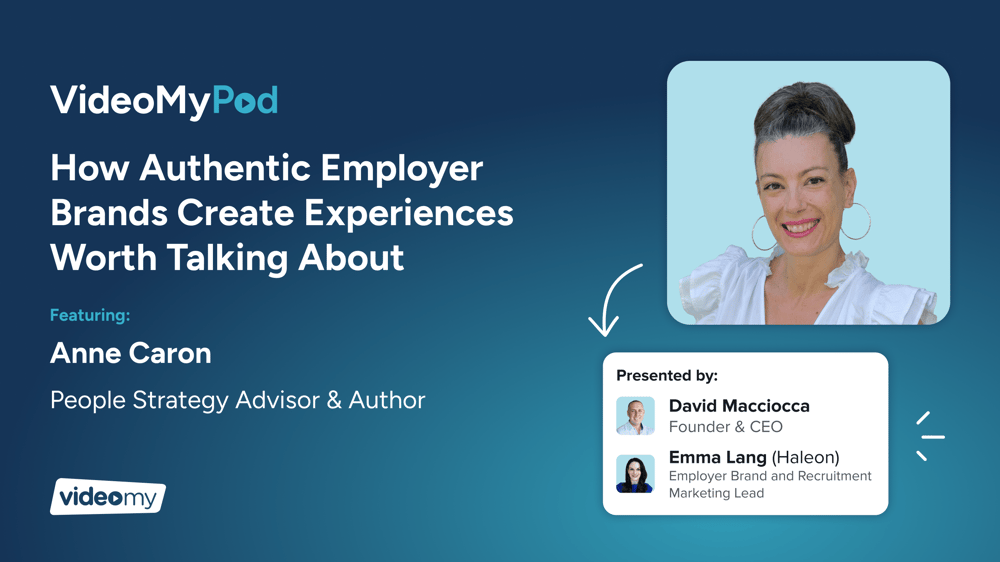
Anne joined the Singapore series of the VideoMy Pod, and revealed why the most powerful employer branding comes from trusting your employees – and why CEOs need to lead that charge.
The CEO Sets the Tone (All of It)
Anne doesn't mince words about where employer brand starts: "90% of the company culture comes from the CEO. So that's why I focus on the CEO." This isn't just motivational speak. It's operational fact. When you walk into an organisation and the culture feels different, it's because the leadership changed.
"No matter the size of the organisation, when there is a change in CEO, you do feel that at every layer."
For CEOs uncomfortable with this reality, Anne prescribes something specific: get a coach. "You need to have an advisor, a coach, either one or both. The coach will help you identify who you are, but also help you see those blind spots."
This self-awareness work isn't optional. It's foundational because "people will not remember what you say as a leader. They will remember how you make them feel."
Create the "Cookie Effect" Instead of Policies
Anne introduced the concept she created years ago at Google: the "cookie effect." It's simple but profound. When you go to a coffee shop, you expect hot coffee. If the cup is dirty, you'll tell your friends not to go. But if there's an amazing cookie on the side? You'll take a picture and bring your friends back.
"What you want to do as an organisation is create a cookie effect with your candidates and your employees. You need to create those experiences because that's the only thing that you control."
This reframes the entire conversation. Don't write policies. Design experiences. "It's not expensive. A lot of people think employer branding requires budget. It's not a budget – it's an intention."
Anne's example? During a three to six-month recruitment process, collect candidate birthdays and send a note even if they're rejected. Automation makes it scalable. Intention makes it authentic.
Stop Writing Policies Based on Fear
Here's where Anne gets provocative: most policies don't solve problems, they just punish the majority for the mistakes of the few. "People who are making mistakes will not stop because there's a policy. That's either they don't know or they don't care. But for the rest of the people, that policy is telling them we don't trust you."
She points to Netflix's "Judgment" value as the gold standard: treat employees like grown adults. If they abuse the system, they're out. But don't infantilise capable people with rules they already know. "The result is that the other 99% of your workforce is being told: we don't trust you to know this."
Trust Your Employees to Tell the True Story
The hardest part for most leaders? Trusting employees to share authentic stories without approval processes. Anne's position is clear: "If you don't trust your employees to tell the right stories, there's something wrong earlier on that journey."
She does offer this nuance: larger regulated organisations may need guardrails, but even then, the goal is different. Train employees on personal branding. Equip them with guidelines. Not restrictions, but frameworks. Then get out of the way. "The moment you give everyone a license and tool them up, it's like throwing fuel on the fire."
Create "Magic Moments" and Amplify Them
At Google, Anne's team created a tradition called "My Google Magic Moment" – an all-hands where employees shared stories of meaningful experiences. One woman described how colleagues pooled their vacation days so she could take extended leave when her mother was ill. Another talked about being hired while pregnant and never feeling that was a problem.
These moments aren't manufactured. They're discovered. "Capture them. Get two or three people who have a great story ready to share, comfortable sharing it. It will trigger more. The snowball effect."
The Non-Negotiable: All-Hands Meetings
Anne is uncompromising on one thing: all-hands meetings are non-negotiable for CEOs. "I'm on the back of my clients for months until they actually roll out the all-hands because for me, that's a non-negotiable. You need to be in front of your team and be able to take on these questions. If you can't, that's a problem."
This is where the narrative stays real. Answer hard questions. Say "I don't know." Be honest about who you are as an organisation. "The more you repeat that context, the more it becomes clearer to people."
🎥 Watch the Episode
🎧 Listen to the Podcast