

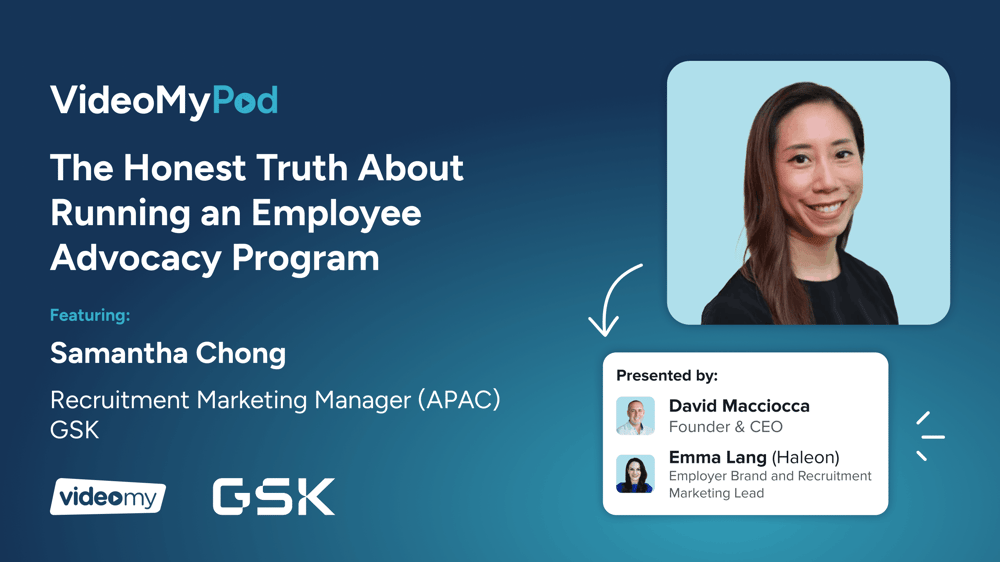
Most organisations overthink ambassador programs before they even start. Samantha Chong, who leads recruitment marketing and employer brand campaigns, has learned the hard way: the best programs don't start with budgets, templates, or perfect strategies. They start scrappy.
In the most recent VideoMy Pod episode, Samantha shared how she scaled ambassador programs from a handful of recruiters to a structured, company-wide movement, as well as why fighting the urge to over-engineer is the secret to success.
Start With Your Recruiters (They're Your Low-Hanging Fruit)
Samantha's first lesson is counterintuitive: don't start with your most enthusiastic employees. Start with the team closest to the talent – your recruiters.
"We know we didn't start with budgets. It's usually we got to do things for free. So how are we going to do that and who are we going to use? So immediately it's myself and the immediate team that I'm working with, the recruiters."
The logic is simple: recruiters are already selling the company to talent. Give them the tools, and they become your foundation.
"Figuring out with them how to enable them to sell the company to talent because that's what we're really doing. We want to attract talent and ambassadors, they are going to help us do that."
The Scrappiness Is a Feature, Not a Bug
Here's where most programs fail: they wait for perfection before launching. Samantha didn't.
"Learning from each other and just testing it out. So kind of creating it still on brand. So using the brand assets that we have. But how is that interpreted by them themselves and then posted out? T hat's where that authenticity comes from as well. It's not perfect and it doesn't need to be perfect."
This permission to be imperfect is liberating. Your ambassadors don't need polished scripts or studio-quality videos, they need confidence. "Once you've kind of handed them a few tools or a template, then you know it's off they go."
You Can't Force It—And That's Okay
The moment Samantha stopped trying to mandate participation was when things accelerated. "You can't force it. You can't force people to do it. Obviously you can suggest and nominate, but at the end of the day, they need to be able to feel it or want to do it too, otherwise it's just going to fall and fail."
This doesn't mean you can't recruit ambassadors strategically. Samantha looks for people already active on social media, watches for employees sharing authentic moments (like one who posted candidly about paternity leave), and actively nominates hiring managers.
"You've got low hanging fruit right? Exactly. Ask the hiring managers. They're experts in their area. What has your career been like? Why do you enjoy working here? Why should someone come and join this company, join you? That's exactly why you should share your story."
"Freedom Within the Frame" Beats Rigid Governance
Structure matters, but not in the way most brands think. Samantha embraced "freedom within the frame" – clear boundaries with room to experiment. "We do have guidelines and we need to stay within them. It's that expectation of, okay, this is the guideline so here's the box, but you can come this far out of the box and there's tolerance."
This approach actually builds confidence. "It gives people confidence that they know the framework they've got to respect and work within. If anything, it can help people move forward."
The payoff? Creativity. Different markets surprise her. "China's way ahead of the curve in their creativity. We've seen some great gamification, panel discussions, quizzes. The way they're creating videos with so much animation. It's so different and maybe not within the strict brand, but the engagement and the way they're interacting with the audience kind of outweighs it. So it gets approved."
Three Keys to Sustained Participation
Samantha's closing advice distills years of learning:
One: Don't over-script it. "We can't over-script it because you want that genuine, authentic stories to be carried by them, not just told robotically."
Two: Find what's in it for them. "What's in it for them? You've got to pitch it. Some people like to be rewarded or recognised or feel good about doing it. It's personal."
Three: Recognise that structure emerges naturally. Once a few ambassadors find success, others want in. "You start to get more buy in. When you've got a few examples and you're getting engagement and people are starting to get interested to say, 'Hey, how come that job role has a video? Can my job have one too?' That's when you start building a case."
The ambassador program doesn't need to be perfect before launch. It needs to be real.
🎥 Watch the Episode
🎧 Listen to the Podcast