

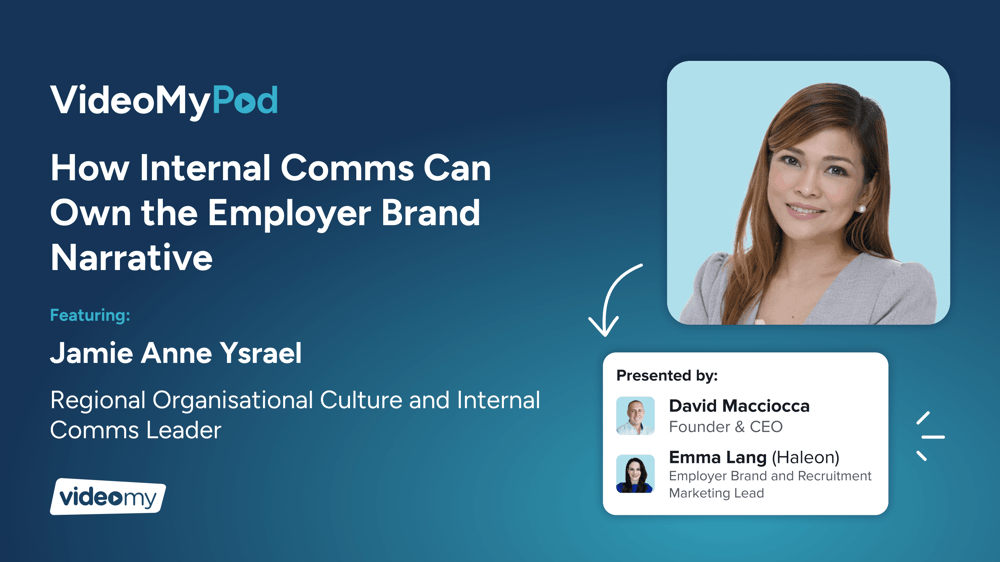
Jamie Anne Ysrael has seen the connection from both sides. Starting in marketing and advertising for tech brands, she eventually moved into the people space, building employer brand and culture teams, then progressing into regional internal communications and culture roles.
In our most recent VideoMy Pod episode, Jamie Anne shared how her multi-disciplinary background informs her approach. Her perspective is clear: "Whether you're talking to consumers, to candidates, or to employees, everything is about people connection and engagement."
Yet most organisations treat internal communications as separate from employer brand. Jamie Anne's doing something different, and the results prove it matters.
Leadership Alignment Sets the Trajectory
For Jamie, building authentic culture starts at the top. "Everything starts with leadership first. They build the identity of the company and constantly rebuild that. They define the business strategy not just for the business now but for the business in the future. And that trickles into what kind of culture do we need to support that strategy."
This alignment isn't just about clarity, it's about longevity. As companies evolve, so must their culture and the people they attract. "As companies evolve, the culture has to evolve and the type of people that we want to keep and attract will also evolve along that way. And that feeds the base and the heart of what the employer brand is, not just for now but also three to five or ten years after."
Sitting in internal communications rather than talent acquisition gives Jamie a unique vantage point. She's thinking about culture evolution, not just next quarter's hiring targets.
Your Internal Platforms Are Your Testing Ground
One of Jamie's most practical insights? Use your internal platforms as a testing ground before going external. She's created internal Instagram-style channels, blogs and instant messaging platforms where employees naturally share experiences.
"You can AB test before it even goes out to market. If you create raw videos and see they perform really well on your own internal platforms because you can measure it (look at comments, see it's authentic, people are loving it), then you might feel safer going external. Let's try it, or clean it up a little bit, but you've got the foundations there."
This approach does double duty. The employees engaging internally are often the exact talent you want to attract externally. "The type of people that you would want to engage with and attract with your content externally because they're already in your company. If they've stayed in your company for long, they are the type of talent you would want to also hire and attract."
The Power of Authentic Over Polished
Jamie's candid about the mistakes she's seen: overly polished content that feels inauthentic. "Working in employer brand, we used to design all these nice videos of how employees are. We did a very authentic vlog type of content working with leaders and some employees, just very raw, natural footage of what they're doing every day, and it worked so well internally."
The lesson applies to leadership content too. "Not all leaders can naturally be engaging. Some are very business focused and straightforward. If they suddenly appear vibrant and engaging, it's not authentic and people will see through that. It's really more about getting to know that leader and seeing how we position them. Maybe they're not as engaging, so it could be simple quotations because they have insights they can share about certain subjects."
Three Levers to Drive Participation
When it comes to getting employees to create content and share stories, Jamie uses three strategies: recognition, competition, and small incentives.
"Sometimes it's just because everyone's busy, so you have to give them a little bit of motivation. It could be small things – merchandise, bragging rights, recognition. We're going to feature you on our bigger platforms. That gives them visibility. Sometimes it's exclusive tickets, a seat at a town hall, donations to charity in their name, or even one-on-one time with leaders."
The key? Don't overthink it. Small motivations often matter more than grand prizes.
Bridge the Internal-External Gap
Finally, Jamie's advice for alignment: internal communications teams shouldn't wait for permission. "Internal comms people taking the initiative to reach out. Don't wait, just go reach out to your employer branding team. We prepare messages and materials so they're consistent with the culture, and when candidates eventually onboard and become employees, they don't feel the gap. You close the gap on the expectation."
This is where culture becomes oxygen. Jamie puts it simply: "Companies that have good culture are typically companies that communicate really well, and it's not too dissimilar to breathing oxygen. It creates meaningful places of work where people are able to bring their more authentic self and their best self so they can impact projects."
🎥 Watch the Episode
🎧 Listen to the Podcast